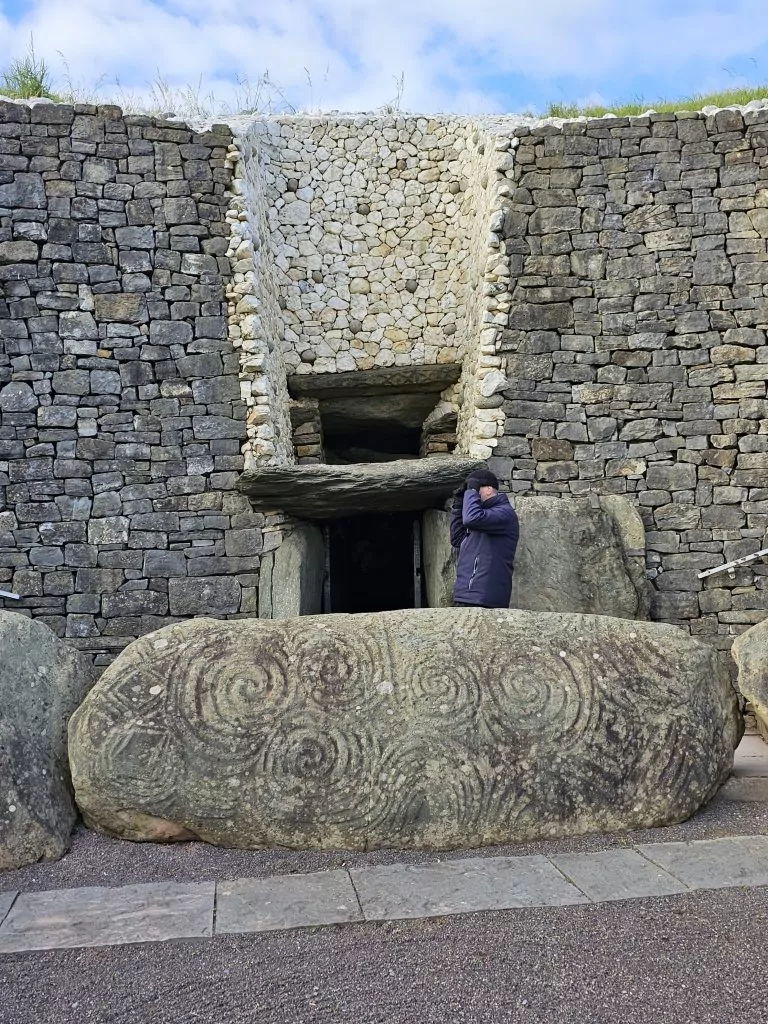
We took a tour out to Tara, Knowth, and Newgrange on Friday, the 17th. These important Irish historical sites are north of Dublin, in the area of the Boyne River valley. They have all been used since the Neolithic period, more than 3,400 years BCE. There are passage grave sites at all three locations with Newgrange and Knowth the best known.
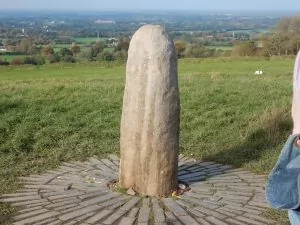
The drive from Dublin was along good, wide roads for some of the way, and then on one-lane roads masquerading as two-lane roads as we got closer to Tara. Tara was once the “home” of Irish kings, of whom 148 were crowned there. On the hill of Tara, which is the highest point for some distance, stands the “Stone of Destiny” which was supposed to cry out when touched by the true king. The hill is now empty of buildings and doesn’t show much history—at least on the surface. We heard plenty of history about the area from Mary Gibbens, our guide, who is an archeologist. We like the style of visit where we can do some prior research, hear from a knowledgeable guide, and then walk the area to get a feel for the land and its feel. Now Tara is less a well-know and protected historical location than a dog-walking park for the locals. It seems like a step down for a place which was once the home of kings.
From there we drove local (think narrow and twisty) roads to the Newgrange visitors center. We were here in2018 and found it to be full of well-presented information. Newgrange and Knowth (and Dowth) are known for their passage tombs. But they are only the largest of hundreds of such tombs in Ireland, Think of a passage tomb as a manmade hill (in various sizes) with an interior structure of large stones which has been covered by earth and grass. They have a passage from the outside to an inner chamber where human and animal remains are often found. The passage tombs were built over a long period, from around 3700 to 2500 BCE (Before Current Era, to be politically correct), with the ones at Brú na Bóinne being built over a much shorter period from around 3300 to 3000 BCE. They continued to be used long after their initial construction.
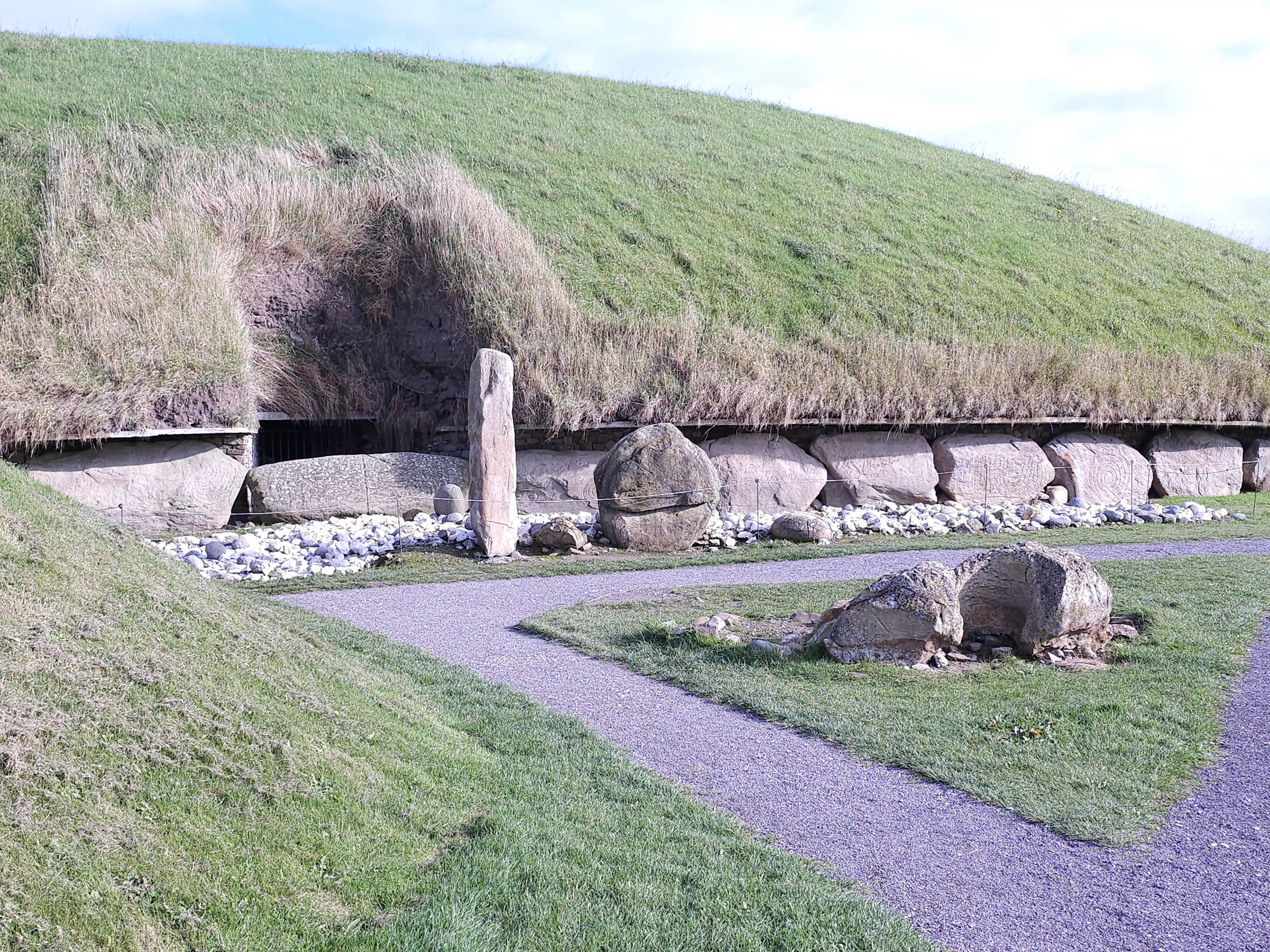
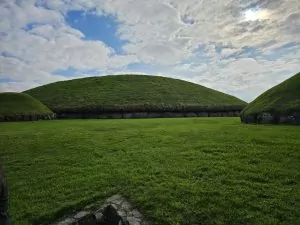
It is possible to go down the passage at Newgrange, which Patricia and I did in 2018 and again on this visit. The passage is low and narrow—it was built for people who were smaller. On our previous visit, I whacked my head pretty good, but this time I only lightly grazed an overhead stone. In part people are allowed in there because it was opened a long time ago and much of the archeological value of the interior destroyed then. For that reason, the Knouth passage tomb is not open to the public and probably never will be. Nevertheless, we learned a lot from Mary Gibbens, at the visitor center, and from the knowledgeable and friendly docents at Knowth and Newgrange. We were even able to climb to the top of the mound at Knowth. Over the years the mound has served as a fort, a small religious community, and a small village. The Knowth site is surrounded by several much smaller passage graves. The group we were with on the Gibbens tour was full of questions , which made the journey and visit pleasant. Mary Gibbens was absolutely full of information about Ireland and the Irish—and full of opinions, too. It was one of the best outings we have had anywhere.
Saturday (the 18th) morning, we visited the EPIC museum. It is dedicated to telling the story of Irish emigration over the years. I am pretty sure EPIC stands for “Every Person Is Connected”. The first part of the self-guided visit was, to use Patricia’s term, a real downer. That was because it concentrated on the miserable conditions-some of which were imposed on the Irish, some of which were natural—which forced so much of the population to leave and the trials they suffered on their journeys and how difficult life was in their new homes for many. The second part was more uplifting because if shows the influence the Irish, both at home and abroad, have had on the world in nearly every area of human endeavor. The museum uses state of the art and innovative graphics to present its information so it is anything but a static collection of “stuff”.
In the afternoon, we took our somewhat delayed hop-on hop-off bus tour of Dublin. We sat on the upper deck of an open top bus. I might mention here, in case you didn’t know, that Ireland is famous for many things, one of which is rain. While the rain keeps Ireland green, it is still RAIN. Fortunately, our bus had a protected area on top and we grabbed seats there as soon as we boarded. Unfortunately, rain covered the windows from time to time, which limited my picture-taking. Many Dublin city streets are congested and one-way, but our driver managed them with no damage to cars or pedestrians.
After the bus tour, we ate at a fancy pizza place (fancy meaning they wanted a reservation) before dodging the last of the raindrops on our way back to the hotel,
I added a number of Dublin and day trip pictures to the pictures page.